Monoammonium Phosphate Fertilizer 12-61-0
- Regular Price
- $ 29.99
- Sale Price
- $ 29.99
- Regular Price
- $ 24.99
Sold Out
- Unit Price
- per
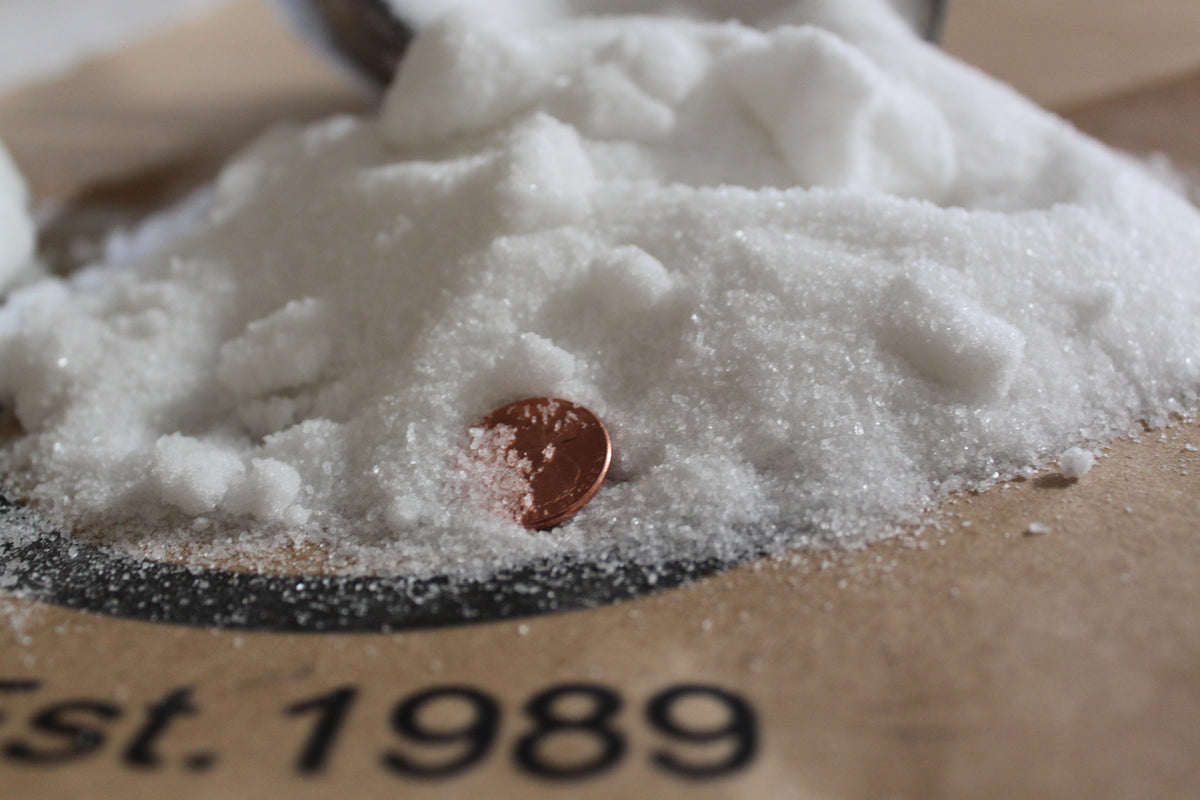
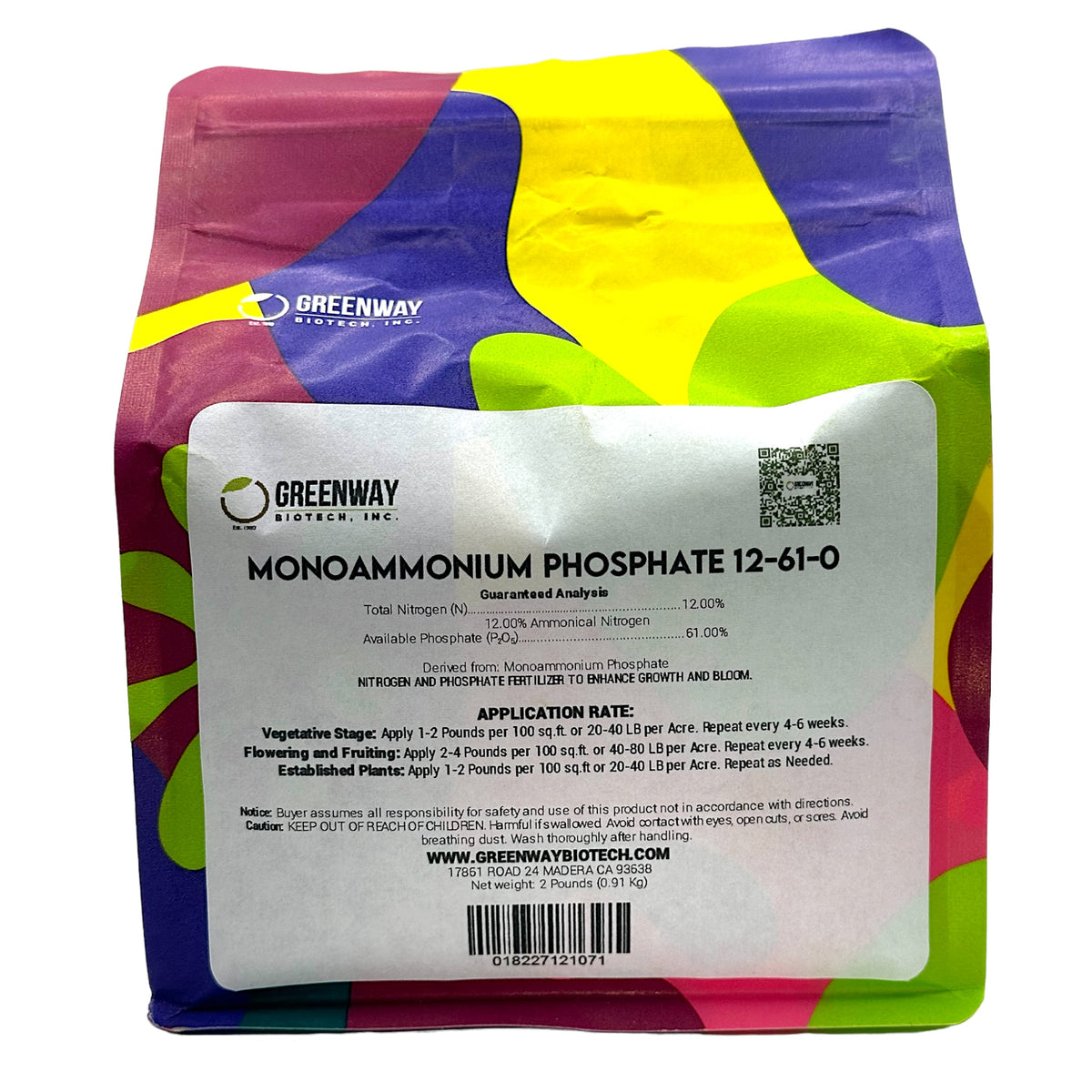
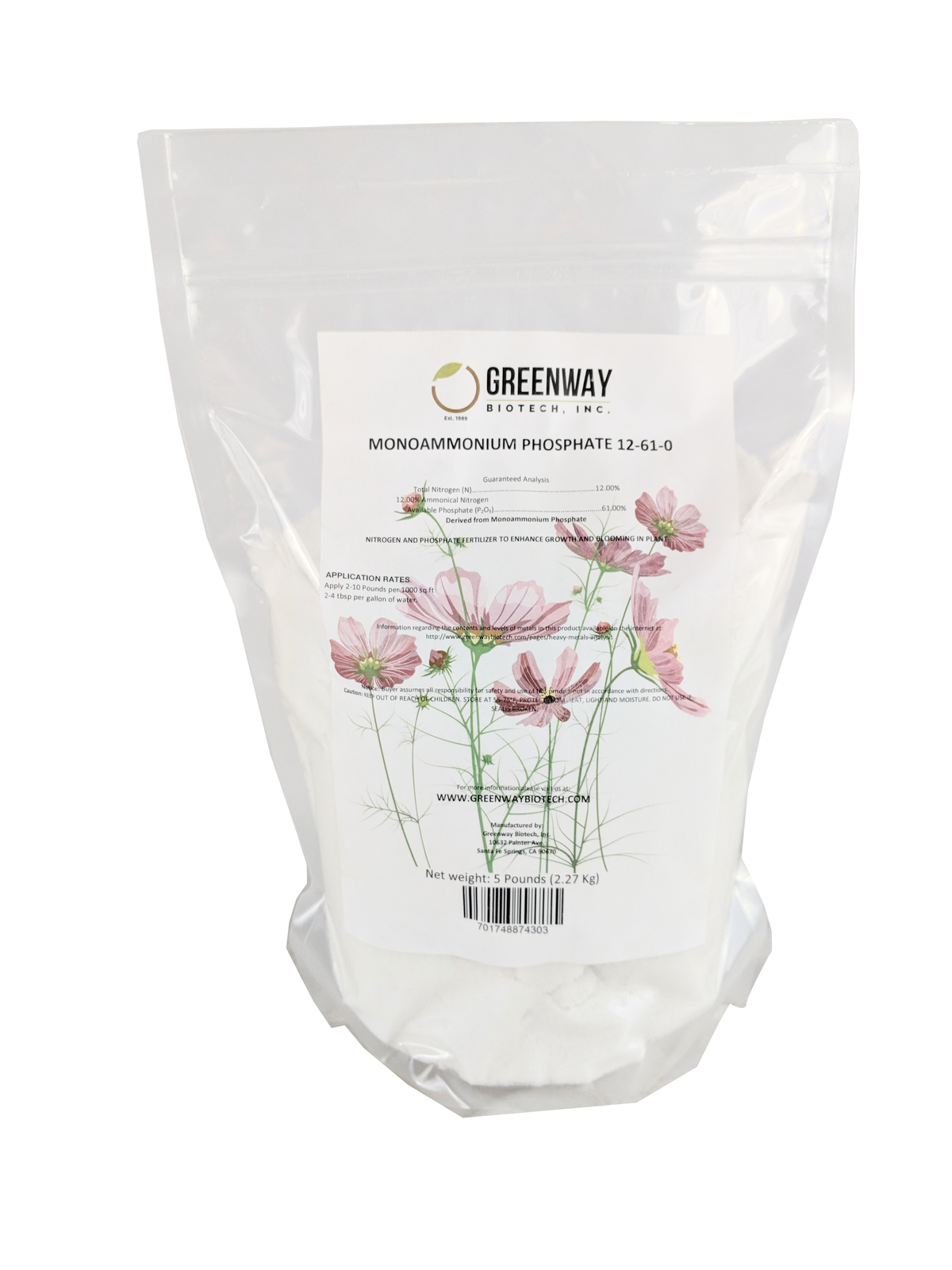
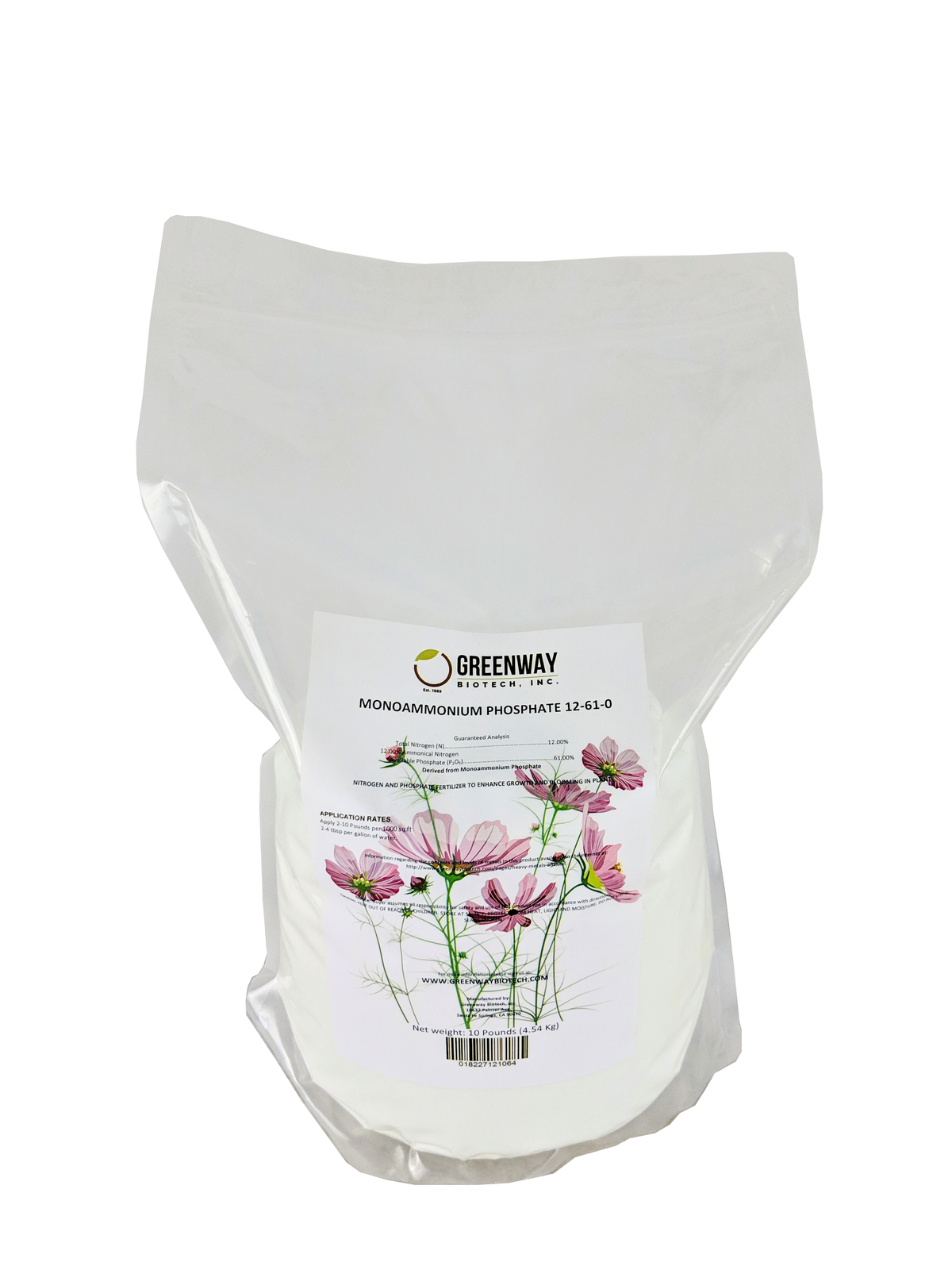
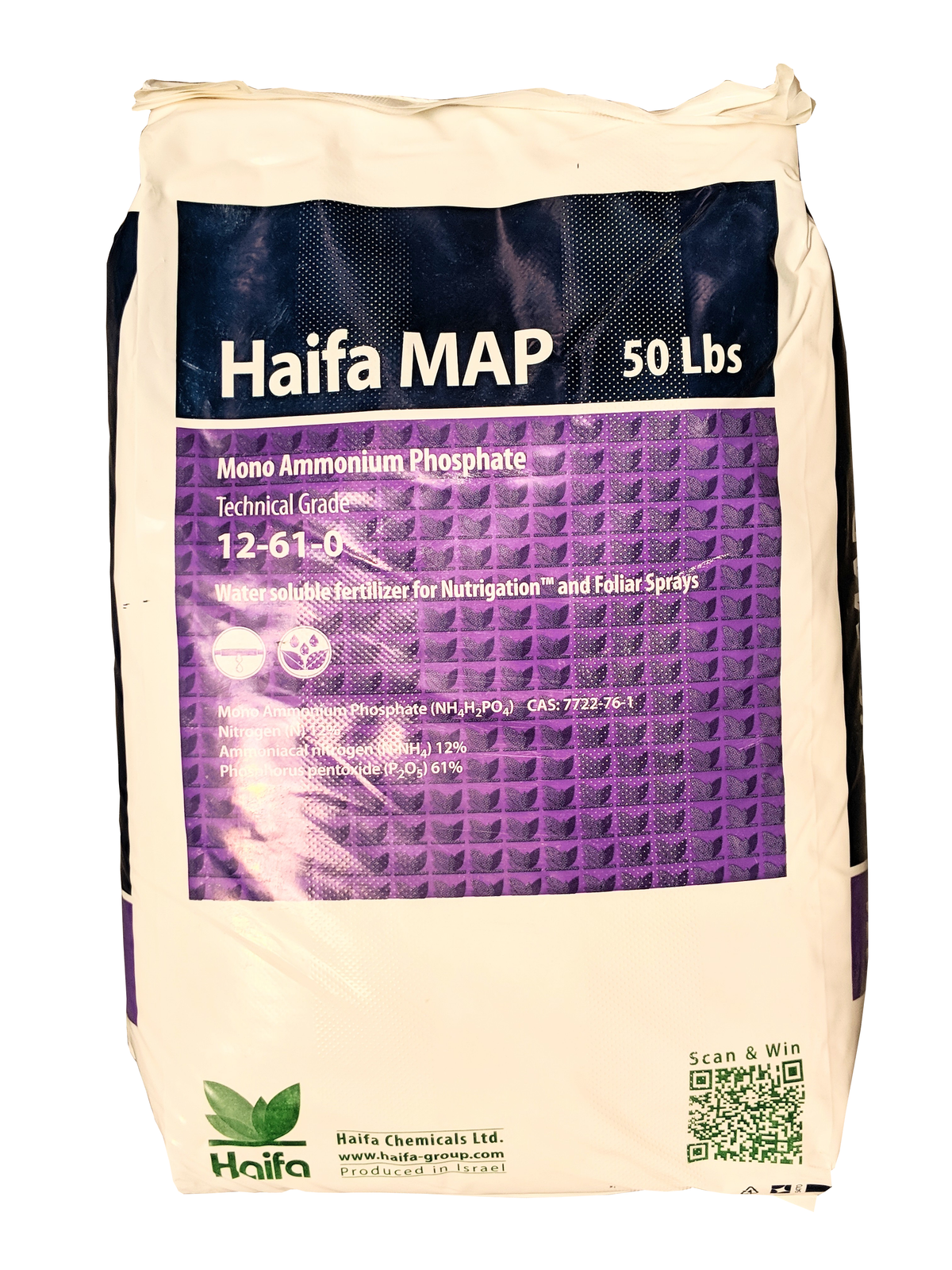
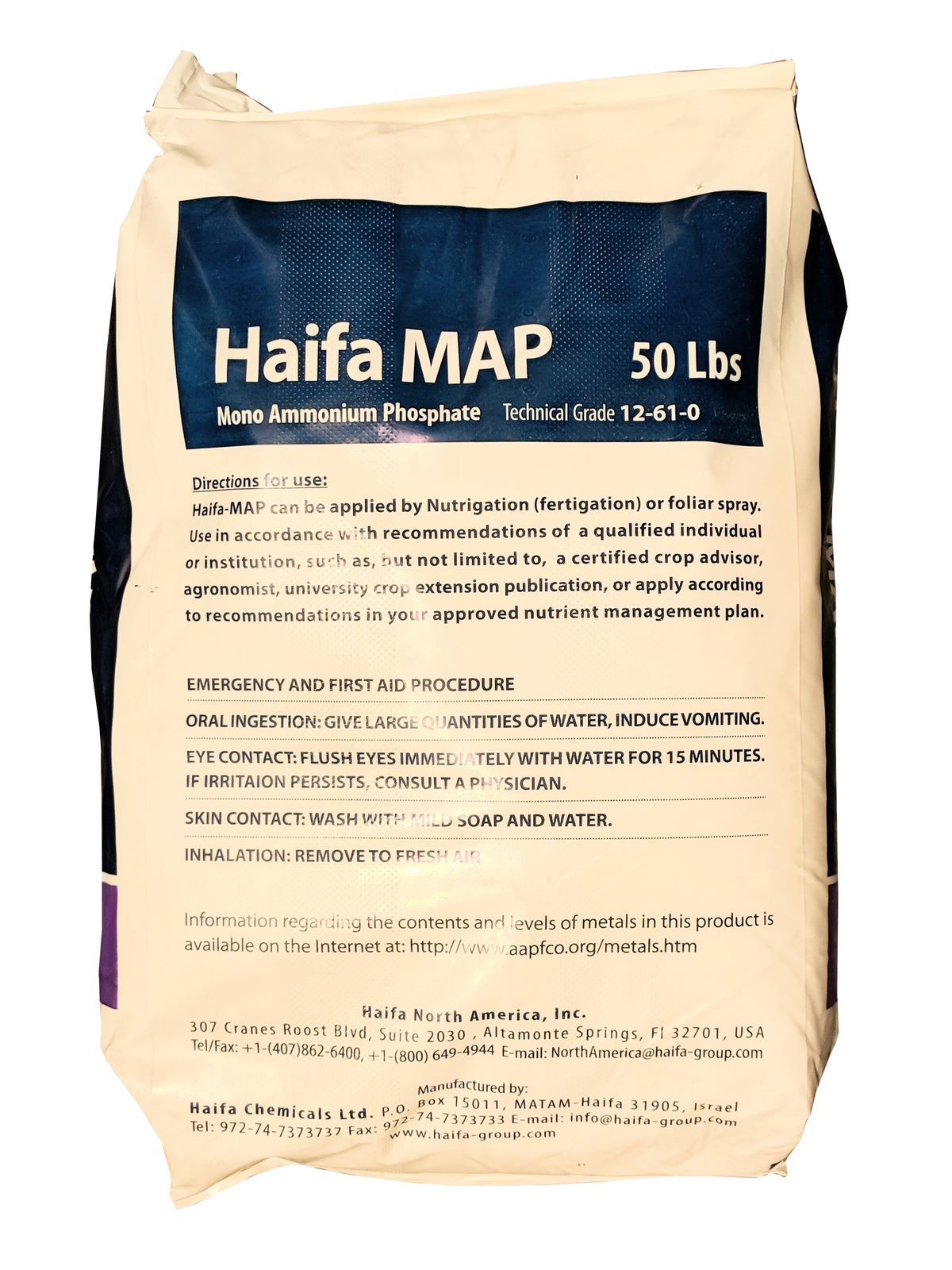
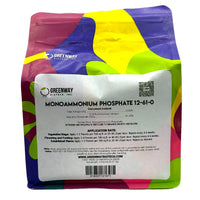
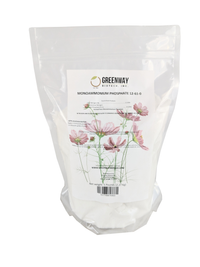
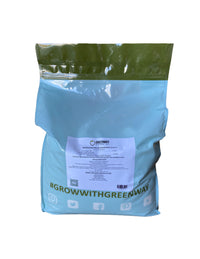
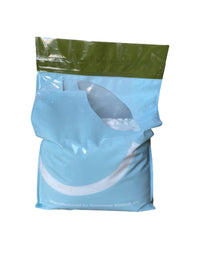
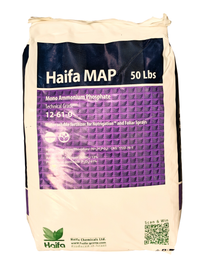
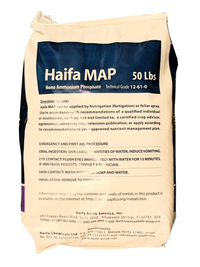
Technical-grade, 100% water-soluble MAP delivering 61% available phosphate (P₂O₅) and 12% ammoniacal nitrogen in every pound. CDFA-registered, third-party heavy-metal tested, and engineered for drip irrigation, fertigation, hydroponics, and starter applications — not for dry broadcast (use granular MAP 11-52-0 for that).
Find your size → Calculate how much I need61%
Available phosphate (P₂O₅) — among the highest of any water-soluble fertilizer
12%
Ammoniacal nitrogen — acidifies the rhizosphere and lifts P availability
270g/L
Solubility at 20°C — dissolves clear, no residue, no clogged emitters
4.5pH
Solution pH (1% w/v) — mildly acidic, ideal for hard or alkaline water
Coverage figures below assume a mid-range vegetable garden rate of about 2 lbs per 100 sq ft soil-applied (dissolved), per the CDFA-registered product label. Fertigation and hydroponic users will get many times more coverage per pound — see the Calculator for exact figures.
| Bag Size | Garden Coverage | Fertigation Coverage | Best For |
|---|---|---|---|
| 1 lb | ~50 sq ft | ~50 gal @ 150 ppm P | Trial use, container plants, foliar test sprays |
| 5 lb | ~250 sq ft | ~240 gal @ 150 ppm P | Most popular Home garden, hobby hydroponics |
| 10 lb | ~500 sq ft | ~485 gal @ 150 ppm P | Larger gardens, small greenhouse fertigation |
| 25 lb | ~1,250 sq ft | ~1,210 gal @ 150 ppm P | Commercial growers, market gardens |
| 50 lb | ~2,500 sq ft | ~2,420 gal @ 150 ppm P | Best value Orchard fertigation, field-scale crops |
Wherever phosphorus needs to move into solution fast — through a drip line, a hydroponic reservoir, a foliar sprayer, or as a banded starter — MAP 12-61-0 is engineered to do it without residue or clogged emitters.
Dissolves to 100–200 ppm P targets cleanly. Run alternate stock tanks — never combine concentrated MAP with calcium nitrate (they precipitate as calcium phosphate).
0.5–1.0 g/gal in a recirculating tank delivers 30–50 ppm P. Always pre-dissolve and add MAP before calcium-bearing nutrients, then re-check pH.
Dissolved and banded 2 inches beside and 2 inches below the seed at planting. The acidic micro-zone keeps P available on cold or high-pH soils.
Begin lifting P rates 1–2 weeks before expected bloom — phosphorus needs to be in tissue before flowers open for full reproductive support.
0.5–1.0% solution (5–10 g/L) as a rescue tool for visible P deficiency. Test on a small area first; avoid mid-day or temperatures above 85°F.
The mild acidity of MAP solutions (pH ~4.5) preserves phosphate availability where neutral or basic conditions normally lock P into unavailable Ca-phosphates.
Six reasons growers running drip, hydroponic, and high-value crop programs reach for technical-grade water-soluble MAP over granular or starter blends.
Each pound of MAP 12-61-0 delivers 0.61 lb of available phosphate — 1.64 lbs of product per lb of P₂O₅ needed. That density matters when you're injecting through a drip line: less product moving through the manifold, lower EC contribution per unit of P, easier solution management.
Solubility of 27 g per 100 mL at 20°C means MAP fully dissociates into NH₄⁺ and H₂PO₄⁻ ions in any reasonable irrigation volume. No fillers, no coatings, no granule breakdown lag. Granular MAP 11-52-0 is the right tool for soil broadcast — for liquid systems, only technical-grade powder will do.
A 1% MAP solution sits at pH 4.0–5.0. Banded near the seed, that acidic micro-zone keeps phosphate from precipitating with calcium and magnesium in high-pH soils. Penn State and Oklahoma State extension data shows banded MAP runs roughly 25% more efficient than broadcast on acidic and calcareous soils.
The 12% N is all in ammonium (NH₄⁺) form. As roots take it up, they release H⁺ into the rhizosphere, which acidifies the immediate root zone — the same effect that protects P from fixation. Ammonium-N also takes up faster than nitrate, fitting the early-season demand window where P matters most.
CDFA registration means every batch carries a guaranteed analysis verified against the registered label. Third-party heavy-metal testing is on file. The current SDS (v4.0, April 2026) and CDFA registered label are downloadable from the Documents section below.
Compared to running calcium nitrate plus a separate phosphate source, MAP delivers both nitrogen and phosphorus from a single dissolved input — one stock tank, one EC contribution, one set of math. For specialty growers running tight reservoir programs, that simplicity is worth real money.
1.64×
lbs of MAP 12-61-0 needed per lb of P₂O₅
Phosphorus is one of the three macronutrients plants demand in large quantities. Inside the plant it's everywhere energy moves — ATP and ADP, the molecules that store and release the energy of every metabolic step; phospholipids that form cell membranes; the sugar-phosphate backbones of DNA and RNA; and the phosphate groups that switch enzymes on and off during signaling. Without adequate phosphorus, cell division slows, root architecture stays shallow, and the hormonal cascade that initiates flower buds simply doesn't fire on schedule.
Monoammonium phosphate (NH₄H₂PO₄, CAS 7722-76-1) is the controlled-purity reaction product of ammonia and phosphoric acid. In water it dissociates into one ammonium ion (NH₄⁺) and one dihydrogen phosphate ion (H₂PO₄⁻) — the same phosphate species roots actively transport at the soil interface. Because the dissociation produces a mildly acidic solution (pH 4.0–5.0 at 1% w/v), MAP also lowers the pH of the immediate root zone, which keeps phosphate in solution where calcium-rich or alkaline soils normally tie it up as insoluble Ca-phosphates.
The grower-facing math is simple. Every published phosphorus recommendation is expressed in pounds of P₂O₅ per acre (or per 1,000 sq ft); MAP 12-61-0 contains 61% P₂O₅ by weight; therefore multiply any P₂O₅ target by 1.64 to get pounds of MAP needed. Need 50 lbs P₂O₅ per acre? Apply 82 lbs of MAP per acre — and you'll also deliver 10 lbs of nitrogen as a bonus.
For more on choosing the right phosphorus source for your situation, see What is the Best Phosphorus Fertilizer? on the Greenway Biotech blog.
Rates below are drawn from university extension publications and peer-reviewed horticultural research, expressed in the unit each source uses (lbs P₂O₅/acre, ppm P, % w/v solution). Convert P₂O₅ targets to lbs of MAP 12-61-0 by multiplying by 1.64. Anchor every decision to a current soil test.
Quick answer: Multiply your soil-test P₂O₅ recommendation by 1.64 to get lbs of MAP 12-61-0 per acre. For "optimal" soil-test corn, that's around 70 lb P₂O₅/ac ≈ 115 lb MAP/ac.
| Crop / Situation | P₂O₅ Target | lbs MAP/ac | Source | Notes |
|---|---|---|---|---|
| Corn, 200 bu yield, optimal STP (20–40 ppm) | 70 lb/ac | ~115 lb/ac | Tri-State (OSU Ext., Purdue, MSU Ext.) | Removal ~0.37 lb P₂O₅/bu |
| Winter wheat, STP 30 (15 ppm), pH > 5.5 | 30 lb/ac | ~49 lb/ac | Oklahoma State Ext. | Banded with seed for best efficiency |
| Winter wheat, same STP but soil pH ~5.1 | 60 lb/ac total | ~98 lb/ac | Oklahoma State Ext. | 30 lb broadcast + additional 30 lb banded with seed |
| Soybean, 60 bu maintenance | 45 lb/ac | ~74 lb/ac | Tri-State; Iowa State Ext. | Removal ~0.75 lb P₂O₅/bu |
| Build-up program (low-test corn-soy) | +100–200 lb above maintenance | ~164–328 lb/ac | UMN Ext.; Iowa State Ext. | 16–18 lb P₂O₅ raises STP by 1 ppm |
| Soils with P-Index > 50 (NC, FL, MN, MD) | 0 lb/ac | Do not apply | NC State Ext. (NCDA&CS) | State P-Index regs cap application |
📋 Soil Test First: Field crop application rates above are general guidelines based on typical soil-test levels and crop removal estimates. Actual rates should be confirmed by a current soil test and consultation with your local cooperative extension service, as needs vary significantly by soil type, crop variety, and regional conditions.
Sources: Tri-State Fertilizer Recommendations (Ohio State University Extension, Purdue Extension, Michigan State University Extension); Oklahoma State University Extension (Raun & Solie wheat P research); University of Minnesota Extension; Iowa State University Extension; NC State Extension / NCDA&CS revised P recommendation equation.
Quick answer: ~100 lbs of starter per acre placed 2 inches beside and 2 inches below the seed (or the lowest planter setting). On small grains, the in-furrow seed-safety ceiling is 15 lb N per acre maximum — with MAP at 12% N, that caps direct-seed-contact placement at ~125 lb MAP/ac.
| Placement | Crop | MAP 12-61-0 rate | N delivered | Source |
|---|---|---|---|---|
| 2×2 placement (2" beside, 2" below seed) | Corn, optimal STP | ~60 lb/ac | ~7 lb N/ac | Penn State Ext. |
| 2×2 sidedress at planting | Corn, low STP / build phase | 50–150 lb/ac | 6–18 lb N/ac | UMN Ext.; OSU Ext. |
| In-furrow seed contact (small grains ceiling) | Winter wheat, barley | ≤ 125 lb/ac MAP | ≤ 15 lb N/ac | Penn State Ext. (15 lb N or 30 lb N+K₂O cap) |
| Acidic-soil seed band (pH < 5.5) | Winter wheat | +49 lb/ac on top of broadcast | +6 lb N/ac | Oklahoma State Ext. |
📋 Banding Caution: Direct seed contact with MAP at rates above the cited ceilings causes salt injury and reduced emergence. The salt index of MAP is moderate (~30 vs. DAP at ~34), but seedling tissue is highly sensitive — always verify your planter's actual placement before increasing rates.
Sources: Penn State University Extension (corn and small grain starter placement); Oklahoma State University Extension (wheat acidic-soil banding); University of Minnesota Extension; Ohio State University Extension.
Quick answer: For greenhouse tomatoes during establishment to flowering, apply about 2.5 kg MAP per hectare per day (~2.2 lb/ac/day) through the drip line — that supplies 1.5 kg P₂O₅/ha/day plus a small N bonus.
| Crop / Stage | P₂O₅ Target | MAP 12-61-0 Equivalent | Source |
|---|---|---|---|
| Tomato, open field, low-Mehlich-1 P soil | 150 lb/ac season total | ~246 lb/ac | UF / IFAS |
| Potato, regardless of soil-test P | ≤ 120 lb/ac | ≤ 197 lb/ac | UF / IFAS BMP |
| Greenhouse tomato, establishment–flowering (daily fertigation) | 1.5 kg P₂O₅/ha/day | 2.5 kg MAP/ha/day (~2.2 lb/ac/day) | Rate doc fertigation example |
| Greenhouse cucumber (fertigation) | 70 ppm P₂O₅ in feed | 115 g MAP/1000 L | Peer-reviewed fertigation work |
| Home / market garden P-only top-up (per 100 ft row) | Soil-test-driven | ~0.16–0.33 lb MAP / 100 ft row | UConn Ext. general veg guideline |
📋 Note: Vegetable P recommendations are highly soil-test dependent — UF / IFAS only recommends the full P rate on soils that test very low. Mid-range soils require lower additions or maintenance-only rates. Pair every vegetable P program with a calcium source (calcium nitrate or Cal-Mag Plus) from a separate stock tank.
Sources: University of Florida / IFAS (tomato and potato BMP recommendations); UConn Cooperative Extension System; peer-reviewed greenhouse fertigation research synthesized in the rate document.
Quick answer: Dose to a P₂O₅ concentration target in ppm. Vegetative stage runs 70–115 ppm P₂O₅ (~115–190 g MAP per 1,000 L). Bloom/fruit-set runs 115–185 ppm P₂O₅ (~190–300 g MAP per 1,000 L). Add MAP before any calcium-bearing nutrients.
| Stage | Target ppm P | P₂O₅ equivalent | MAP per 1,000 L | MAP per 1,000 gal |
|---|---|---|---|---|
| Seedling / transplant | 20–30 ppm | 46–69 ppm | 75–113 g | ~10–15 oz |
| Vegetative | 30–50 ppm | 69–115 ppm | 113–188 g | ~15–25 oz |
| Bloom / fruit set | 50–80 ppm | 115–183 ppm | 188–300 g | ~25–40 oz |
| Recirculating hydroponic maintenance | 30–50 ppm | 69–115 ppm | ~115 g | ~15 oz |
⚠️ Compatibility: MAP is incompatible with calcium- and magnesium-containing fertilizers in concentrated stock solution — calcium phosphate and magnesium ammonium phosphate (struvite) will precipitate and clog emitters. Run two stock tanks (Tank A: Ca-bearing; Tank B: MAP and other phosphates) or alternate injection. Dilute concentrations in the irrigation stream are safe.
Sources: Haifa Group fertigation handbook; peer-reviewed greenhouse cucumber fertigation work; UMN Extension fertigation guidance; standard hydroponic nutrient-program literature.
Quick answer: Foliar phosphorus is a rescue tool, not a primary supply method. Mix a 0.5% solution (5 g/L, ~0.67 oz/gal) for young leaves and most crops; mature leaves on tolerant crops can take 1.0%. Always jar-test, spray early or late, and skip mid-day or temperatures above 85°F.
| Concentration | Per Liter | Per US Gallon | Per 100 gal | Use Case |
|---|---|---|---|---|
| 0.5% solution | 5 g/L | ~0.67 oz/gal (~19 g/gal) | ~6.7 lb/100 gal | Standard rate, young leaves, most crops |
| 1.0% solution | 10 g/L | ~1.3 oz/gal (~38 g/gal) | ~13 lb/100 gal | Mature leaves, tolerant crops, severe deficiency |
| Field foliar rate (carrier 20–50 gal/ac) | — | — | — | 2–5 lb MAP/ac dissolved |
🌿 Foliar safety check: Always test on a small area first. Spray in early morning or late afternoon when foliage is dry; avoid applications above 85°F or in direct mid-day sun. Add a non-ionic surfactant at 0.05–0.1% v/v for coverage. Repeat every 10–14 days for severe deficiency; reassess with a tissue test before stacking more applications. Jar-test before tank-mixing with pesticides.
Sources: Haifa Group / IFA foliar nutrition reference (0.5–1.0% MAP recommendation); peer-reviewed foliar P research (Khan et al., University of Agriculture Peshawar — safety margin to ~16.5 g/L KH₂PO₄ equivalent).
Four steps for every use case — from a 5-gallon hydro reservoir to a 100-acre drip system. Then run the calculator below for your exact numbers.
MAP density varies with humidity. Use a kitchen or postal scale (grams for hydro, ounces for fertigation, pounds for field). One tablespoon weighs roughly 15 g, but never substitute for a measured weight when ppm targets matter.
Add MAP to a small volume of warm (not hot) water and stir until completely clear — usually 30 seconds. Cold reservoir water dissolves MAP fine but takes longer; warm pre-dissolution prevents settling at the bottom of stock tanks.
In hydroponic and fertigation systems, MAP belongs in Tank B with other phosphates and sulfates. Tank A holds calcium nitrate and Cal-Mag Plus. Never combine concentrated MAP with concentrated calcium — calcium phosphate precipitate will clog emitters.
MAP lowers solution pH (it's mildly acidic). In hydroponic reservoirs, target 5.8–6.2 for most crops; for blueberries and ericaceous plants run 5.2–5.5. In drip fertigation, the final dilution usually self-corrects — but verify with a meter when working with already-acidic source water.
Phosphorus sources differ in solubility, accompanying nutrients, and best-fit application method. Use the table to pick the right tool, then see our full phosphorus fertilizer comparison for deeper context.
| Product | NPK | Solubility | Best For | Notes |
|---|---|---|---|---|
| MAP 12-61-0 Water-Soluble (this product) | 12-61-0 | 100% soluble | Drip, hydroponics, foliar, starter | Highest P₂O₅ in water-soluble form; mildly acidic; pairs N + P |
| MAP 11-52-0 Granular | 11-52-0 | Granular — soil only | Broadcast, soil incorporation, dry blends | Lower cost per lb P₂O₅; not for liquid systems |
| MKP 0-52-34 | 0-52-34 | 100% soluble | Bloom / fruit set when N is not wanted | Supplies K alongside P; near-neutral pH; no N |
| Calcium Nitrate 15.5-0-0 | 15.5-0-0 | 100% soluble | Tank A in hydroponics; calcium nutrition | No P — must be paired with MAP or MKP from a separate tank |
| Bone Meal 3-15-0 | 3-15-0 | Slow-release organic | Pre-plant soil incorporation, perennials | Releases over months, not days; not for hydro or fertigation |
A short decision aid — for any phosphorus question this doesn't cover, email questions@greenwaybiotech.com with your soil test and crop.
A balanced fertigation or hydroponic program runs MAP from Tank B (with potassium and sulfate sources) and calcium nitrate from Tank A. Magnesium and chelated iron round it out.
The standard Tank A nitrogen and calcium source. Never combine concentrated Cal-Nit with concentrated MAP — calcium phosphate precipitates. Run from a separate stock tank.
Bloom BoosterAdds 34% K₂O alongside 52% P₂O₅ with no nitrogen — the right tool when bloom and fruit set are the priority and you want to taper N.
Tank B — PotassiumSupplies K₂O and sulfur without chloride. Pairs cleanly with MAP in the same stock tank for a P + K + S program.
MicronutrientHigh-P programs can suppress iron uptake by competing for root transporters. Add chelated iron to prevent interveinal chlorosis during intensive MAP feeding.
MAP 12-61-0 is GHS Category 2B (eye irritation) and Category 3 (mild skin irritation) per the current SDS v4.0. Signal word: WARNING.
If your question isn't here, contact our team at questions@greenwaybiotech.com — we typically respond within one business day.
They are two different physical grades of monoammonium phosphate for two different application methods. MAP 12-61-0 is a technical-grade water-soluble powder with 12% N and 61% P₂O₅ — it dissolves completely and is designed for drip irrigation, fertigation, hydroponics, and foliar spray. MAP 11-52-0 is an agricultural-grade granular product with 11% N and 52% P₂O₅ — it does not dissolve cleanly and is intended only for soil broadcast and incorporation.
If you're injecting through any liquid system, choose 12-61-0. If you're broadcasting dry on a field, garden bed, or lawn, choose MAP 11-52-0.
Start with your soil-test P₂O₅ recommendation in lbs per acre, then multiply by 1.64 to get lbs of MAP 12-61-0 per acre. A typical 200-bushel corn target on optimal soil-test P sits around 70 lb P₂O₅/ac, which equals about 115 lb MAP 12-61-0 per acre. A 60-bushel soybean maintenance is around 45 lb P₂O₅/ac, or about 74 lb MAP per acre.
The Application Rates section above breaks down field, banded starter, vegetable, fertigation, and foliar rates with university extension citations.
Not in concentrated form. Phosphate ions from MAP and calcium ions from calcium nitrate react to form calcium phosphate — an insoluble white precipitate that clogs injectors, emitters, and tank outlets. Always use separate stock tanks: MAP goes in Tank B with other phosphates and sulfates; calcium nitrate and Cal-Mag Plus go in Tank A.
When injecting through a single irrigation line, alternate or dilute through the main line so they only mix in the dilute irrigation stream where precipitation is no longer a risk. Standard practice in commercial fertigation.
A 1% MAP solution sits at pH 4.0–5.0 because the dihydrogen phosphate ion (H₂PO₄⁻) is mildly acidic. In most situations this is helpful — it preserves phosphate availability in alkaline soils (where high pH causes calcium phosphate precipitation), helps dissolve calcium carbonate scale in hard water, and keeps nutrients in plant-available ionic forms.
In hydroponics, measure reservoir pH after adding MAP and adjust back to your target (5.8–6.2 for most crops, 5.2–5.5 for blueberries). In drip fertigation, the final dilution typically self-corrects — verify with a meter if your source water is already below pH 6.0.
Use a 0.5% solution (5 g/L, ~0.67 oz/gal, or ~6.7 lb per 100 gal) for most crops, especially on young or sensitive foliage. Mature leaves on tolerant crops can take a 1.0% solution (~13 lb per 100 gal), but always jar-test first and apply to a small area before full coverage. Foliar phosphorus is a rescue or supplemental tool — not a substitute for soil-applied P.
Spray early morning or late afternoon when foliage is dry; skip mid-day and any application above 85°F. Add a non-ionic surfactant at 0.05–0.1% v/v for coverage. Repeat every 10–14 days for severe deficiency and reassess with a tissue test before stacking applications.
Yes — MAP 12-61-0 is one of the standard phosphorus sources in hydroponic nutrient solutions. Dose to 0.5–1.0 g per gallon of reservoir for 30–50 ppm P during vegetative growth, or higher for bloom (see the Fertigation rate panel). Because MAP is acidic, always measure and adjust pH after adding it — target 5.8–6.2 for most crops.
Critical: add pre-dissolved MAP to the reservoir before any calcium-bearing nutrient (calcium nitrate, Cal-Mag Plus), or use separate Tank A / Tank B stock solutions. Direct contact between concentrated MAP and concentrated calcium will form calcium phosphate precipitate.
Sustained high phosphorus in soil or solution can suppress uptake of zinc, iron, and manganese by competing for the same root transport sites. This is most relevant in heavy-fertigation programs where EC and P concentrations stay elevated for weeks — less of an issue in seasonally-applied field programs.
Watch for interveinal chlorosis on new growth (iron) or stunted small leaves (zinc). Supplement with Chelated Iron EDTA or Chelated Zinc EDTA if needed. Staying within the rates listed in the Application Rates section significantly reduces this risk.
Three things. First, the 61% P₂O₅ density delivers a lot of phosphorus from a small banded volume — you can place 60 lb of product per acre and supply 37 lb of P₂O₅ right where roots will hit it. Second, the acidic micro-zone around dissolving MAP keeps phosphate in plant-available form even in calcareous or high-pH soils where broadcast P often gets fixed. Third, the 12% ammoniacal nitrogen taken up alongside phosphate further acidifies the rhizosphere, compounding the availability effect.
Penn State and Oklahoma State extension research consistently shows banded MAP runs roughly 25% more efficient than broadcast on acidic or calcareous soils. Place 2 inches beside and 2 inches below the seed, and watch the in-furrow seed-safety ceiling (15 lb N per acre on small grains).
Yes. MAP 12-61-0 is independently lab-tested for heavy metal content, with results consistently well below required regulatory limits. The CDFA registration label references the AAPFCO heavy-metals reporting site (aapfco.org/metals.html) for industry data on phosphate sources. For our most recent third-party analysis, contact us at questions@greenwaybiotech.com.
MAP 12-61-0 ships from our Madera, California facility in sealed bags from 1 lb home-garden sizes up to 50 lb commercial sacks. Free shipping on orders over $100. Every order is backed by our 90-day money-back guarantee.
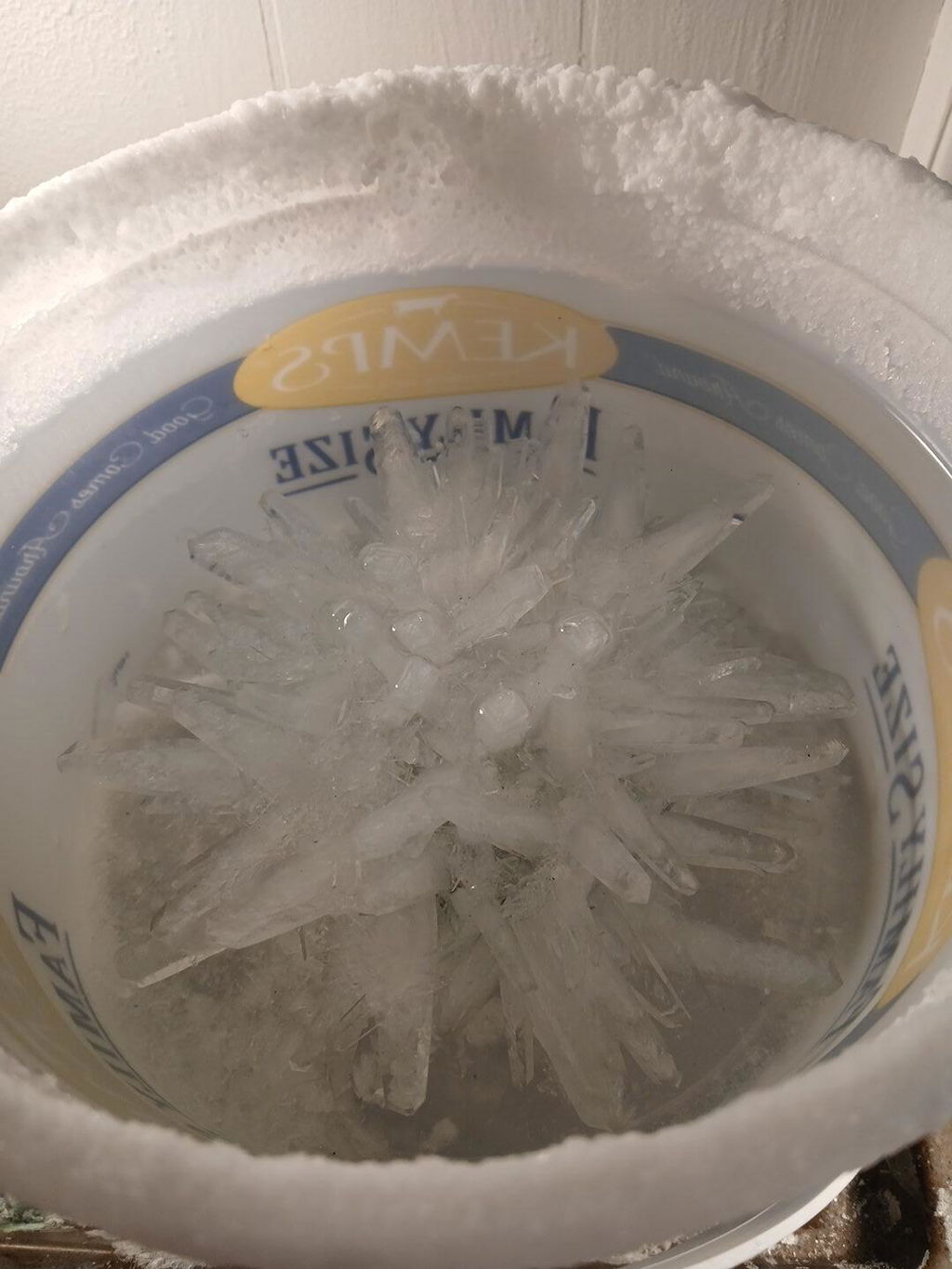
Choose your size →I admit i use it to grow crystals, by it sure is h great for the purpose. Excellent, even. The purity is also excellent, it came very quickly. I will continue to buy it.
Product was fine- but the change of shipping method was disappointing. I paid forFedEx to receive on Sunday. It was switched to USPS- which delayed delivery until Tuesday night.
the product is good but the pakaging is poor for the second time I recived the pakage badly dammaged the inner pakaged rupured and all contents were loose in the outer pakage had to cleen and repakage in a baggie
Thank you so much for your honest feedback and for taking the time to leave a 5-star review despite the packaging issues.
We sincerely apologize for the damaged packaging you've experienced twice now. You're absolutely right to bring this to our attention, and we truly appreciate your patience as we work through this challenge.
We recently transitioned to compostable packaging as part of our commitment to sustainability, but we're aware that this has unfortunately led to an increase in shipping damage. We're actively working on sourcing more durable compostable alternatives that will better protect your order during transit while maintaining our environmental values.
In the meantime, we'd love to make this right for you. Please reach out to us directly so we can send you a replacement with extra protective packaging, and we'll cover any inconvenience this has caused.
Your feedback helps us improve, and we're committed to finding packaging solutions that protect both your products and our planet. Thank you for your understanding as we work toward a better solution.
Easy to use and quick delivery
Still haven’t even received the item from fed ex.. it was due to arrive 3/29
In progress currently
Have used as part of my personal foliar regimen for years and have always liked the product. Definitely appreciate the speedy service. Would definitely buy from you again.
awsome product, will order again
I am using this as part of a fire retardant formula. Ordering was easy and shipping was quick.
will see in the next week but from everyone I talked with I have no wrries~~
not receive the package yet
It dissolves well without any apparent residue, and it's my go-to phosphorus source.
It met my expectations which are based on positive experiences with other Greenway products.
Thanks for quick delivery!
My oder came quickly. I am satisfied with the service and the product.
it was great! love it!
After my kids got one of those cheap little crystal growing kits, that comes with just enough base material to make a palm size crystal, I decided like any self respecting awesome dad to make the kids some mega-crystals. A little googlizing turns out Monoammonium Phosphate is the powder in the crystal kit. 7 days later the crystals are the size of my face, and the kids love the science. Thanks. Great price, great product, quick shipping. Will certainly buy more, cause the next ones are gonna be grown in a 5 gallon bucket, oh yeah.
The package was not robust so one of the bag was broken and the chemical is all over the package.