Chelated Manganese EDTA Fertilizer
- Regular Price
- $ 29.99
- Sale Price
- $ 29.99
- Regular Price
- $ 28.99
Sold Out
- Unit Price
- per
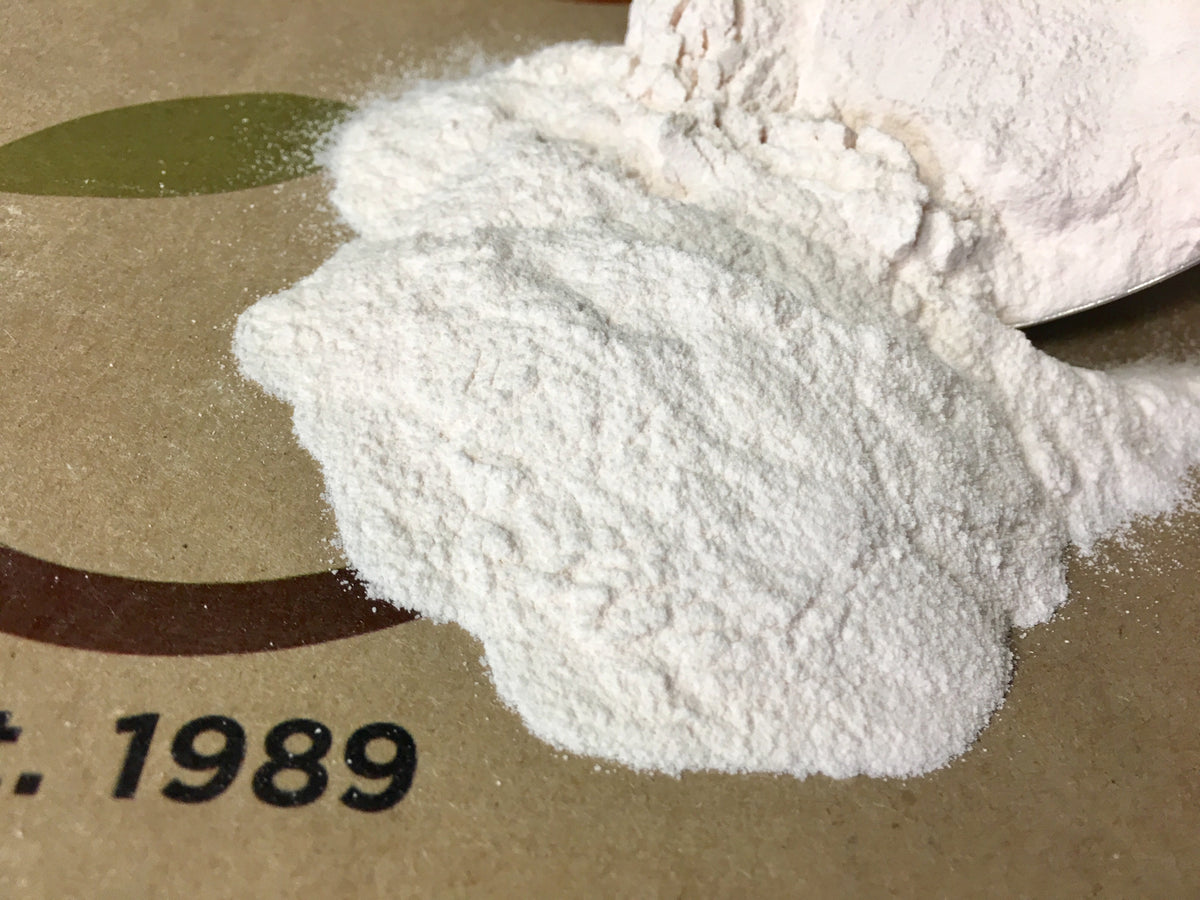
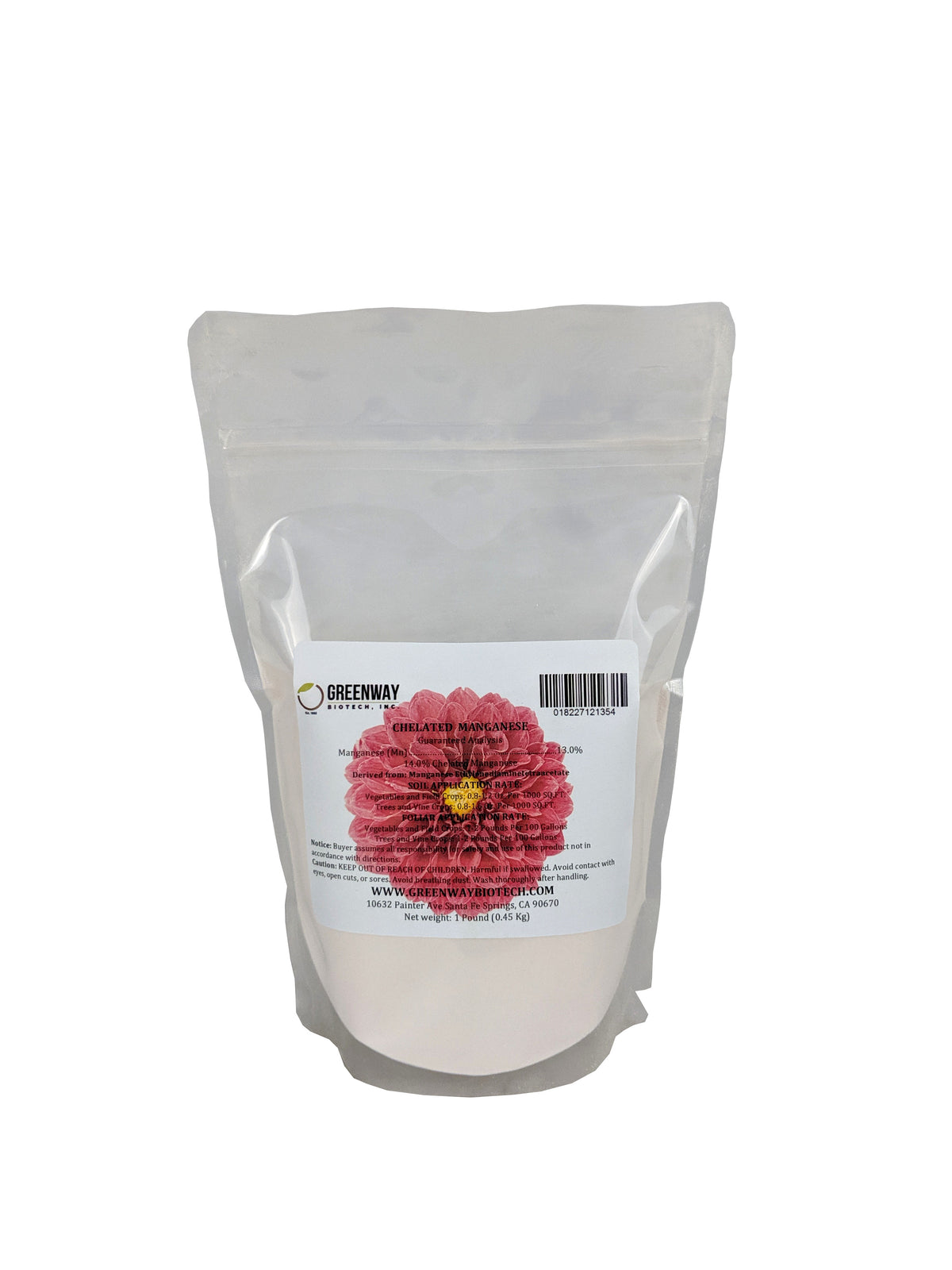
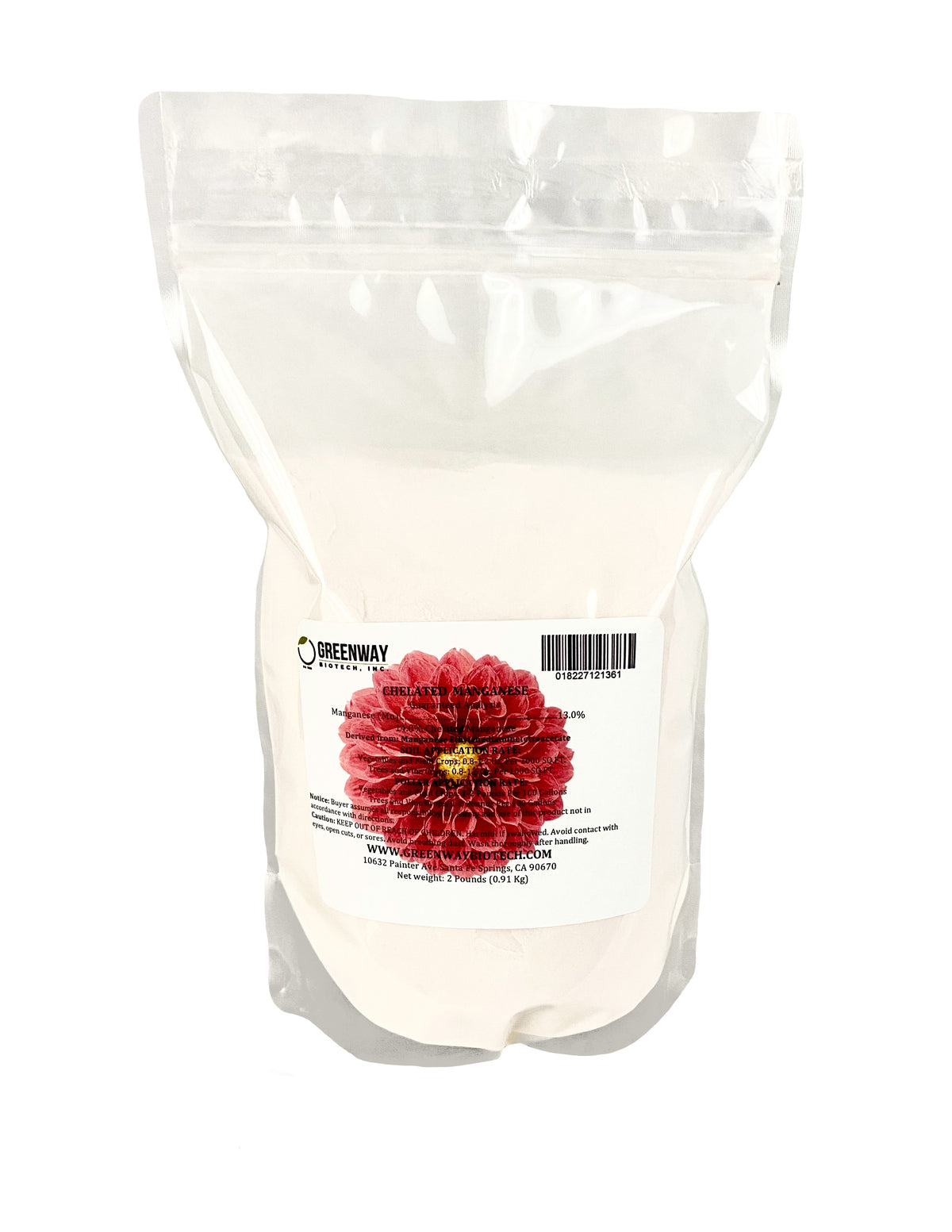
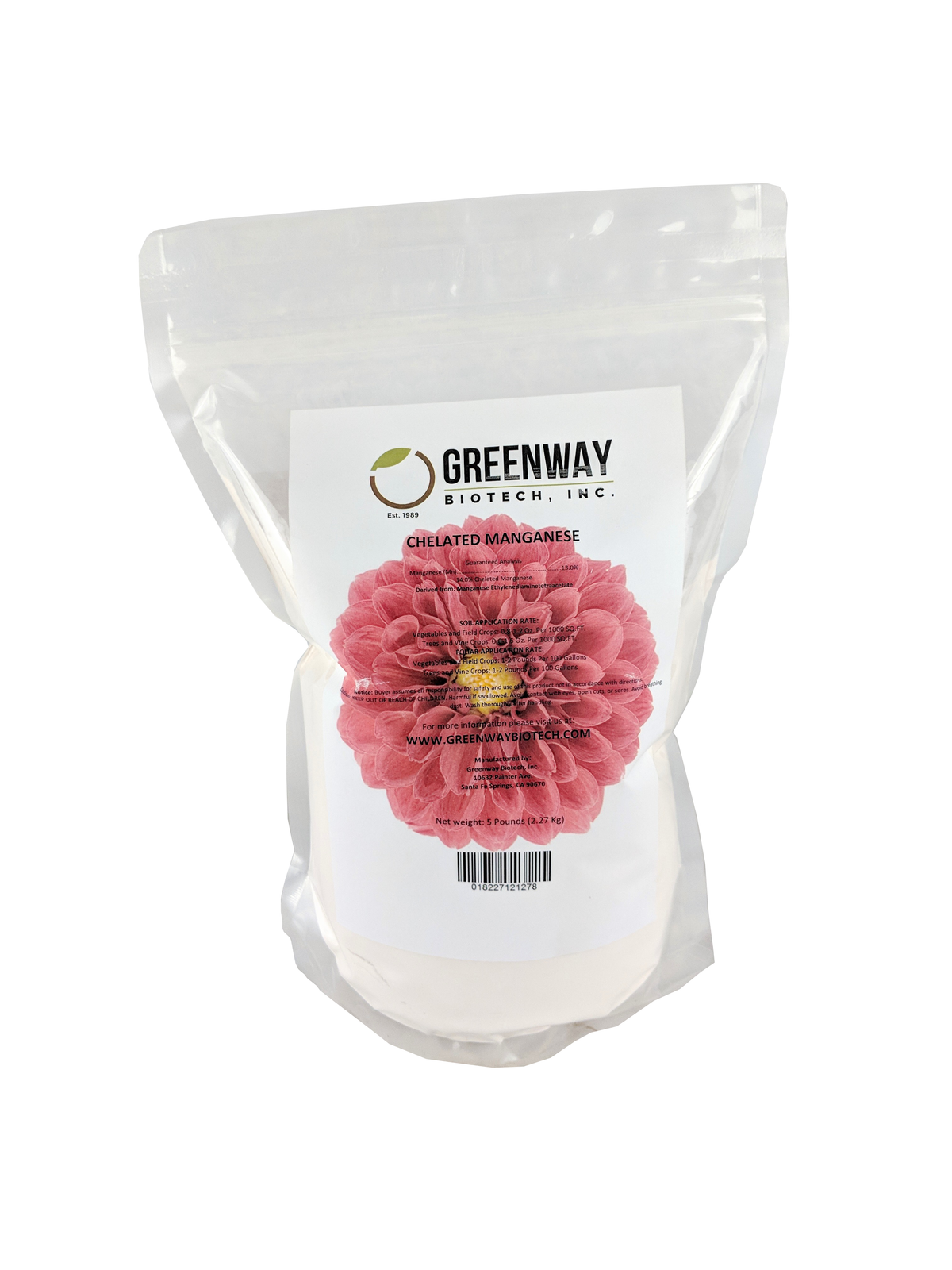
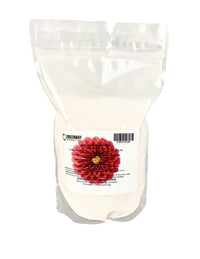
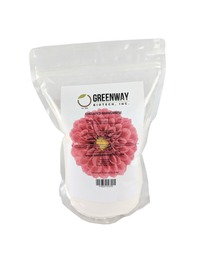
A water-soluble, EDTA-chelated manganese source for growers correcting interveinal chlorosis on middle-aged leaves. The chelate keeps manganese plant-available from pH 4.0 to 7.0 — the range where sulfate forms rapidly oxidize and lock up. CDFA registered, third-party lab tested, and equally at home in soil, foliar, and hydroponic programs.
Find your size → Calculate how much I need13%
Chelated manganese, delivered per application
4.0–7.0pH
Plant-available range where the EDTA chelate holds
7–14days
Typical window for visible foliar greening
35+yrs
Family-owned California fertilizer manufacturing
Coverage estimates below assume a foliar program at roughly 1–2 tsp per gallon and a soil program near the middle of published field-crop rates. Actual use depends on crop, deficiency severity, and application method — the calculator further down will size it precisely for your situation.
| Bag Size | Foliar Coverage (approx.) | Soil / Field Coverage (approx.) | Best For |
|---|---|---|---|
| 1 lb | ~45–90 gallons of spray | Spot-treats small beds & containers | Home gardeners, trial use |
| 2 lb | ~90–180 gallons of spray | Up to ~0.5 acre at maintenance rates | Larger gardens, small orchards |
| 5 lb | ~225–450 gallons of spray | ~1 acre foliar correction program | Most popular |
| 10 lb | ~450–900 gallons of spray | 1–2 acres, repeat applications | Commercial vegetable & field crops |
| 25 lb | ~1,100–2,200 gallons of spray | Multi-acre seasonal program | Best value |
Because the EDTA chelate dissolves cleanly and resists soil lock-up, a single product can move across foliar, soil, and hydroponic programs — with the strongest results where soil pH would otherwise immobilize manganese.
The fastest route to correcting visible deficiency. Leaf-applied manganese bypasses soil pH entirely and typically shows greening in new growth within 7–14 days.
Banding near the seed row is more reliable than broadcasting, since broadcast manganese fixes rapidly in soil. Best paired with a soil test.
Citrus, pecans, and stone fruit in alkaline orchard soils respond well to a spring-flush foliar spray on two-thirds-expanded leaves.
Dissolves without residue for recirculating and substrate systems. Most crops target a low working concentration — manganese needs are far lower than iron.
Best applied as a light foliar feed. Mn-EDTA is less likely to burn than manganese sulfate and stays available in higher-pH, limed soils.
Compatible with most drip and injector programs. EDTA-chelated Mn is the preferred form when tank-mixing with glyphosate — apply at lower rates to avoid leaf burn.
A manganese source is only as good as the manganese the plant can actually take up. Here is the case for the chelated form.
At 13% chelated manganese, each application delivers a substantial amount of plant-available Mn — which can allow lower application rates and fewer repeat passes than dilute or non-chelated sources.
Above roughly pH 5.5, unchelated Mn rapidly oxidizes to insoluble manganese oxides. The EDTA chelate protects manganese against that reaction up to about pH 7.0 — covering most garden, turf, and agricultural soils. For a fuller comparison, see Manganese Sulfate 31% Mn.
Dissolves completely with no sediment, making it well-suited to drip irrigation, fertigation, foliar sprayers, and hydroponic reservoirs without clogging emitters or nozzles.
Registered with the California Department of Food and Agriculture and independently tested for heavy metals by third-party laboratories, with results consistently well below required limits.
Foliar spray, soil band, fertigation input, or hydroponic additive — the same bag supports an entire manganese program. It also pairs naturally with the other EDTA micronutrients in a complete chelated stack.
35+ enzymes
Activated or regulated by manganese in higher plants
Manganese is a transition-metal micronutrient required in small but non-negotiable quantities. Its most critical role is in the oxygen-evolving complex of Photosystem II — the site where water molecules are split to release the oxygen and electrons that drive photosynthesis. When manganese is short, photosynthetic efficiency falls, and the plant signals it through interveinal chlorosis: yellow tissue between still-green veins.
Beyond photosynthesis, manganese activates or regulates dozens of plant enzymes, including nitrate reductase in nitrogen assimilation, enzymes in lignin biosynthesis, and manganese-superoxide dismutase, which helps plants manage reactive oxygen species. Research also suggests that manganese-sufficient plants produce more lignin and phenolic compounds, which may support plant defense responses.
The practical problem is chemistry. At soil pH above roughly 5.5, manganese in its ionic form (Mn2+) oxidizes toward insoluble manganese oxides and becomes unavailable to roots. The EDTA ligand wraps the manganese ion in a stable ring structure that resists this reaction, keeping it plant-available across the pH 4.0–7.0 band. Above about pH 7.0, no EDTA chelate fully holds — which is why foliar application becomes the more reliable route in strongly alkaline soils.
For deeper coverage of why chelated micronutrients behave differently from sulfate salts, see Sulfate vs. Chelated Fertilizers and our overview of essential micronutrients for healthier plants.
Rates below are drawn from university extension research and peer-reviewed sources, expressed for this 13% Mn EDTA product. Manganese deficiency closely mimics iron deficiency — confirm with a tissue or soil test before treating.
A simple workflow for foliar, soil, and hydroponic use — then size the exact amount with the calculator.
Manganese deficiency shows interveinal chlorosis on middle-aged leaves, while iron deficiency hits the youngest growth. A tissue or soil test removes the guesswork before you treat.
Fill the sprayer or reservoir partway, add the measured amount of Mn-EDTA, then top up and agitate until fully dissolved. For hydroponics, a stock solution gives the most precise dosing at low concentrations.
Spray foliar in early morning or late afternoon, never in midday heat or above 85°F. Cover both leaf surfaces. For soil, apply to the root zone and water in. Repeat every 7–14 days for foliar until new growth is uniformly green.
Manganese toxicity can occur in sensitive crops, and excess Mn can induce iron deficiency. Stay within published rates, use the lower end first, and split applications rather than spraying one heavy pass.
The right manganese source depends mostly on your soil pH. For a detailed breakdown, see Sulfate vs. Chelated Fertilizers.
| Product | Manganese | Effective pH Range | Best For | Notes |
|---|---|---|---|---|
| Chelated Manganese EDTA 13% (this product) | 13% chelated Mn | pH 4.0–7.0 | Neutral to slightly alkaline soils, hydroponics, fast foliar correction | Resists soil lock-up; tank-mix friendly; preferred for glyphosate mixes |
| Manganese Sulfate 31% Mn | 31% Mn | Mainly below pH 5.5 | Very acidic soils, sulfur supplementation, lowest cost per unit Mn | Oxidizes and locks up above pH 5.5; unreliable in most garden soils |
| Chelated Iron EDTA 13% | Iron, not manganese | pH 4.0–7.0 | Interveinal chlorosis on the youngest leaves | Use when chlorosis appears on new growth — that pattern indicates iron, not manganese |
| Chelated Zinc EDTA | Zinc, not manganese | pH 4.0–7.0 | Zinc deficiency — little-leaf in citrus, pecans, stone fruit | Complementary micronutrient; often deficient alongside Mn in high-pH soils |
Chelated Manganese EDTA is built for one job — keeping manganese available where soil chemistry would otherwise tie it up. Here is when it fits, and when another product serves you better.
Micronutrient deficiencies rarely travel alone, especially in high-pH soils. These EDTA-chelated companions round out a complete micronutrient stack.
Corrects iron chlorosis on the youngest leaves — the complementary micronutrient to manganese in any complete foliar program.
ZincZinc activates enzyme systems alongside manganese, supporting growth regulation, protein synthesis, and pollen viability.
CopperCopper supports lignin formation and electron transport, and is often deficient alongside manganese in organic and high-pH soils.
Calcium + MgSupplies calcium and magnesium for hydroponic and coco programs — magnesium drives the same photosynthetic pathways manganese supports.
Chelated Manganese EDTA is not classified as hazardous, but it is an industrial agricultural input — handle it with the same care you would any concentrated fertilizer salt.
If your question isn't here, contact our team at questions@greenwaybiotech.com.
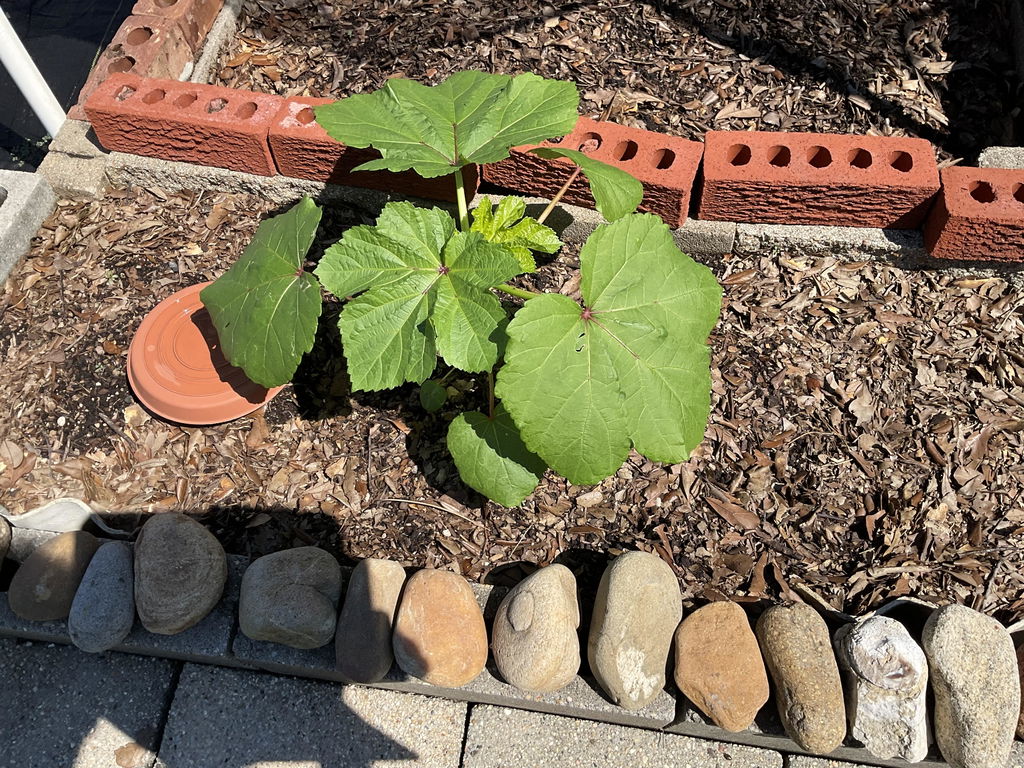
Manganese deficiency shows a characteristic interveinal chlorosis pattern — yellowing between leaf veins while the veins themselves stay green. Crucially, this appears first on middle-aged leaves, which distinguishes it from iron deficiency, which affects the youngest leaves. As the deficiency progresses, small gray or tan necrotic spots may develop on the chlorotic tissue, and you may see delayed maturity and reduced root development. Symptoms are most common when soil pH exceeds about 6.5, in organic or high-humus soils, and during cool wet springs when manganese uptake is naturally reduced. A tissue or soil test gives a definitive answer.
Both cause interveinal chlorosis, but the location of the affected leaves is the key clue. Manganese deficiency starts on middle-aged leaves and moves upward; iron deficiency starts on the newest, youngest growth. Soil conditions differ too — iron deficiency is most common in calcareous, high-pH soils, while manganese deficiency occurs across a broader range of high-pH and organic soils. When in doubt, a plant tissue test settles it. If chlorosis is on new growth, see Chelated Iron EDTA 13% instead.
The core difference is pH stability. Manganese sulfate is effective mainly below about pH 5.5, where Mn2+ stays soluble. Above that range — which covers most garden soils, turf, and agricultural land — unchelated manganese rapidly oxidizes to insoluble manganese oxides and becomes unavailable to plants. Chelated Mn-EDTA remains plant-available up to about pH 7.0 because the EDTA ligand resists that oxidation reaction. Chelated forms typically cost more per unit of manganese but often need lower rates and fewer repeat applications in problem soils. For a fuller comparison, see Sulfate vs. Chelated Fertilizers and Manganese Sulfate 31% Mn.
Yes — it is well-suited to hydroponic use because it dissolves cleanly and stays stable across the typical hydroponic pH band of 5.5–6.5. Most crops target a low working concentration, roughly 0.3–0.8 ppm manganese, with 1–2 ppm reserved for high-demand crops or correcting a measured deficiency. Manganese needs are much lower than iron, and excess manganese can induce iron deficiency, so verify your baseline before dosing — most complete hydroponic nutrients already include some manganese. Use the calculator above to size the exact amount for your reservoir.
Soybeans, wheat, oats, and other small grains are among the most manganese-sensitive field crops. In the vegetable garden, potatoes, onions, sugar beets, peas, and brassicas are frequently affected. Citrus and stone fruit trees commonly show manganese deficiency in alkaline orchard soils, and turfgrass in high-pH or heavily limed soils can develop interveinal chlorosis. Nursery crops in peat-based media above pH 6.5 are also prone to it. Growers in high-pH regions often include chelated manganese in preventive micronutrient spray programs.
This product is 13% chelated manganese by weight, so each pound of product supplies about 0.13 lb of elemental manganese. Most university extension recommendations are written on an elemental-manganese basis, so to convert: 1 lb of elemental Mn equals roughly 7.7 lbs of product. For example, a foliar program calling for 0.5–1.0 lb elemental Mn per acre translates to about 3.8–7.7 lbs of this product per acre. The Application Rates section above lists rates in both product weight and elemental-Mn basis.
EDTA-chelated manganese is specifically the preferred form when tank-mixing with glyphosate, since manganese sulfate or oxide can reduce glyphosate efficacy. The tradeoff is that Mn-EDTA must be applied at lower rates — under about 1 lb elemental Mn per acre — to avoid burning leaf tissue, so more than one application may be needed. A recommended tank order is water, then ammonium sulfate, then glyphosate, then Mn-EDTA. For other combinations, dilute each product separately and jar-test before mixing at scale.
Foliar application is the fastest correction method because it bypasses soil pH entirely. Manganese is absorbed through the leaf surface within a day, existing yellowing typically halts within the first week, and new growth usually emerges visibly greener within 7–14 days. Full canopy recovery follows as new tissue replaces affected leaves. Existing severely chlorotic leaves rarely green up fully — watch new growth as the indicator of recovery. Results vary with deficiency severity, crop type, soil temperature, moisture, and overall plant health.
Chelated Manganese EDTA ships in sizes from 1 lb up to 25 lb, with free shipping on orders over $100. Every order is backed by our 90-day money-back guarantee — if you're not satisfied, return the unused portion for a full refund.
Choose your size →